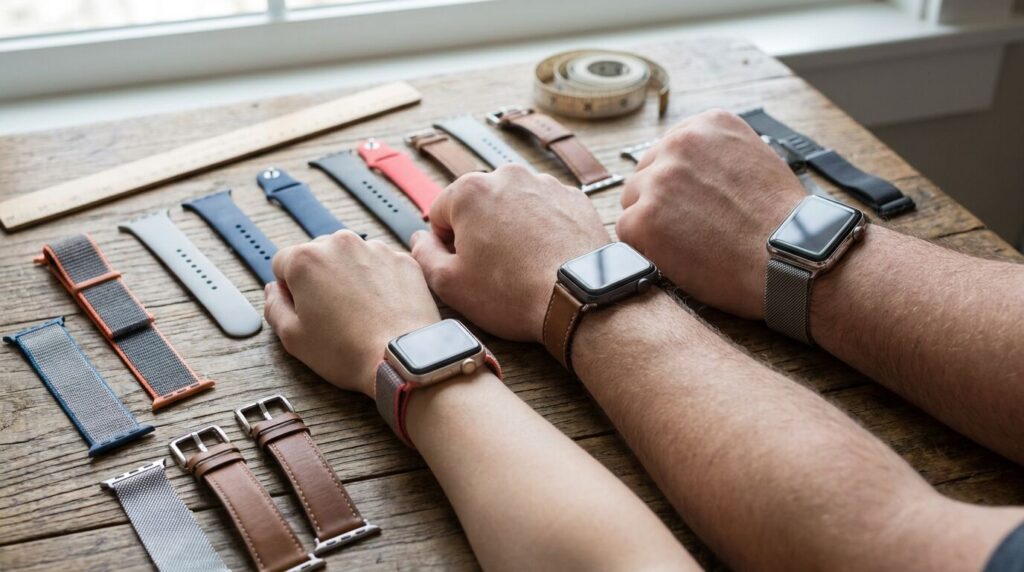
In Brief
›Wrist measurement is everything: Measuring your wrist circumference before buying any Apple Watch band is the single most important step, especially for non-adjustable styles.
›Case size drives compatibility: Apple Watch bands are grouped by case size (38/40/41mm or 42/44/45/49mm), and choosing the wrong group means your band simply won’t attach.
›Solo Loop requires precision: Unlike clasp-based bands, the Solo Loop and Braided Solo Loop have no adjustment mechanism — getting the right numeric size from the start is critical.
›Every wrist is different: Small wrists, large wrists, and everything in between each benefit from different band families — there is no one-size-fits-all answer.
›Try before you commit: Apple’s in-store experience and return policies exist precisely to take the guesswork out of band sizing — use them.
Picking an Apple Watch band sounds deceptively simple — until you’re standing in front of a wall of silicone, leather, and woven nylon options, unsure whether the band you love will actually stay on your wrist properly. The reality is that Apple Watch band sizing sits at the intersection of hardware engineering, personal anatomy, and lifestyle preference. A band that fits perfectly on someone with a 145mm wrist will feel like a loose bracelet on a 180mm one. And beyond pure aesthetics, a poor fit can genuinely interfere with the health sensors embedded in every modern Apple Watch — heart rate monitoring, blood oxygen readings, and ECG accuracy all depend on consistent skin contact. The stakes, in other words, are higher than they seem. Apple has steadily expanded its band ecosystem across generations, from the original 42mm and 38mm cases to the current lineup spanning 41mm, 45mm, and the rugged 49mm Apple Watch Ultra 2 body. Each case size, each band material, and each closure mechanism comes with its own sizing logic. Understanding that logic is what separates a frustrating purchase from one that feels — literally and figuratively — just right.
Why Accurate Wrist Measurement is Crucial for Apple Watch Band Size
Before browsing band options, there is one task that cannot be skipped: measuring your wrist. It sounds trivial, but the wrist circumference you record will determine not just which band size you order, but which band types are even viable options for you. Apple Watch bands come in two broad size categories within each case group, typically labeled S/M and M/L, but some styles — particularly the Solo Loop — use up to nine or ten discrete numeric sizes. A difference of just 5 millimeters in wrist circumference can mean the difference between a size 5 and a size 6 Solo Loop, and those two sizes do not behave the same way on the wrist.
Beyond the Solo Loop family, accurate measurement protects your investment. Returning a band because it’s slightly too loose or uncomfortably snug costs time, and in some cases, the band may show signs of wear that complicate exchanges. Starting with a precise number eliminates most of that uncertainty before it becomes a problem.
How to Measure Your Wrist Correctly for the Perfect Apple Watch Band Fit
The most reliable approach uses a flexible fabric measuring tape — the kind found in any sewing kit. Wrap it around your wrist just below the wrist bone, exactly where you’d wear your Apple Watch. The tape should be snug but not tight: you should be able to slide a single finger underneath it without strain. Record the measurement in millimeters; if your tape reads in inches, multiply by 25.4 to convert. For instance, a 6.5-inch wrist equals approximately 165mm — a figure you’ll reference repeatedly when filtering band options on Apple’s website.
No measuring tape? A strip of paper or a length of string works just as well. Wrap the paper or string around your wrist, mark where the two ends meet, then lay the strip flat against a ruler. The principle is identical. Apple itself provides a printable sizing guide that you can cut out and wrap around your wrist directly — a particularly handy tool for Solo Loop purchases when an in-store visit isn’t convenient. The key is to take the measurement twice, especially if you’re between sizes, and err on the side of the slightly larger measurement for all-day wearing comfort.
Using Different Tools for Precise Wrist Circumference Measurement
Digital calipers used for jewelry sizing offer extreme precision, though they’re rarely necessary for Apple Watch bands. More practically, many Apple Stores keep a physical sizing kit — a set of plastic Solo Loop samples — that lets you slide each size onto your wrist and feel the difference before committing. For those who prefer the at-home route, dedicated watch size guides online walk you through the paper-strip method step by step, with printable templates calibrated specifically for Apple Watch band sizing.
One nuance worth knowing: wrist size fluctuates slightly throughout the day. Fingers and wrists tend to swell marginally after physical activity or in warm weather. Measuring in the evening, after normal daily movement, gives you a wrist circumference that reflects typical conditions rather than a morning baseline that might be artificially slim. That small consideration can prevent a Solo Loop from feeling uncomfortably tight after a workout.

Understanding Apple Watch Case Sizes and Their Band Compatibility
Apple Watch has shipped in a range of case sizes since its debut, and that history directly shapes band compatibility today. The current active lineup includes 41mm and 45mm cases for the standard Apple Watch Series 9, a 40mm and 44mm option for the Apple Watch SE, and the formidable 49mm body of the Apple Watch Ultra 2. Earlier generations introduced 38mm, 40mm, 42mm, and 44mm cases. Knowing which era your watch belongs to is the starting point for any band purchase, because Apple organizes its bands around two primary compatibility groups rather than individual millimeter measurements.
Which Apple Watch Case Sizes Match Which Band Sizes
Apple groups its bands into two families based on the lug connector width. Bands designed for 38mm, 40mm, and 41mm cases share the same connector and are interchangeable across those three dimensions. Likewise, bands for 42mm, 44mm, and 45mm cases share a connector, as does the 49mm Apple Watch Ultra case, which uses the larger lug format. This grouping means that a Sport Band purchased for an original 42mm Apple Watch will physically attach to a current 45mm Apple Watch Series 9 without any adapter.
Band Compatibility Group | Compatible Case Sizes | Example Models |
|---|---|---|
Small Case Group | 38mm, 40mm, 41mm | Series 1–3 (38mm), SE/Series 4–6 (40mm), Series 7–9 (41mm) |
Large Case Group | 42mm, 44mm, 45mm, 49mm | Series 1–3 (42mm), SE/Series 4–6 (44mm), Series 7–9 (45mm), Ultra/Ultra 2 (49mm) |
Compatibility Between Older and Newer Apple Watch Band Sizes
One of the most user-friendly aspects of the Apple Watch ecosystem is its backward-compatible band design. Apple maintained the same lug attachment mechanism across nearly a decade of hardware generations, meaning that a Milanese Loop bought in 2016 still snaps onto an Apple Watch Series 9 today. This commitment to compatibility has tangible value: it means your band collection doesn’t become obsolete every time you upgrade your device.
There are exceptions worth noting. The Apple Watch Ultra and Apple Watch Ultra 2 use the larger connector group, so they accept 42/44/45/49mm bands, but their physical case is bulkier, which can affect how some bands — particularly narrow leather ones — look proportionally. Additionally, a small number of specialty bands released at specific times were designed for specific case sizes within a group and may not look or function ideally on every compatible case. Checking band-specific compatibility details on Apple’s product pages before purchasing remains best practice, especially for limited-edition or third-party options. For a thorough breakdown, resources like MacRumors’ Apple Watch band sizing guide offer generation-by-generation compatibility charts.
Choosing the Right Apple Watch Band Size for Small Wrists
Wrists under approximately 140mm in circumference present a specific challenge in the Apple Watch band world. Most standard two-piece bands ship in an S/M and M/L configuration, and for the smallest wrists, the S/M size can still feel slightly roomy — particularly with thicker silicone styles. The good news is that Apple has refined its sizing over the years, and several band families genuinely excel on petite wrists, offering a secure, proportionate fit without looking oversized relative to the watch face.
One practical consideration for smaller wrists is the visual weight of the case itself. A 41mm Apple Watch case or the 40mm Apple Watch SE will sit more naturally on a narrow wrist than the 45mm Apple Watch Ultra case, but band choice amplifies or mitigates that effect significantly. Slimmer bands with low-profile closures keep the overall look balanced and elegant.
Best Band Types for Smaller Wrists and Their Size Ranges
The Sport Loop is arguably the most forgiving band for petite wrists. Its hook-and-loop fastener system adjusts incrementally across a wide range, and the woven nylon fabric lies flat without adding bulk. The S/M Sport Loop fits wrists from roughly 130mm to 180mm, making it genuinely usable even at the small end of the spectrum. Its lightweight feel also means the Apple Watch doesn’t drag forward on the wrist during movement.
The Modern Buckle leather band — available exclusively for the 41mm and smaller case sizes — was designed with slender wrists in mind. Its magnetic butterfly-style clasp allows very fine adjustments, and the band itself is narrow enough to look proportional on wrists as small as 135mm. For active users, the Sport Band in its S/M configuration remains a reliable choice: the silicone is flexible, the pin-and-tuck closure gives multiple fit positions, and the material is sweat-resistant for workouts. For anyone seeking detailed size ranges across all band types, this ultimate guide to Apple Watch band sizes is worth bookmarking.
Selecting Apple Watch Bands for Larger Wrists: Size and Comfort Tips
Larger wrists — generally those measuring above 190mm or 200mm — sometimes fall outside the comfortable range of standard Apple Watch band configurations. The M/L Sport Band, for instance, covers wrists up to approximately 215mm, which covers most people, but those at the upper end may find the tucked tail of the band short or the last pin hole uncomfortably tight. Knowing this in advance points you toward bands with either extended size ranges or genuinely adjustable mechanisms.
Proportionality matters here too, just as it does for smaller wrists. On a larger wrist, the 45mm Apple Watch Series 9 case sits more naturally than the 41mm, and bands with a bolder visual presence — metal links, wider silicone — look intentional rather than diminutive. The relationship between case size and wrist size is a real aesthetic consideration that Apple’s own marketing consistently highlights.
Adjustable Bands vs Fixed Size Bands for Larger Wrist Circumferences
For larger wrists, adjustable band designs offer the most practical value. The Link Bracelet is the gold standard in this regard: individual stainless steel links can be removed to achieve an almost custom fit, and the butterfly clasp provides further micro-adjustment. This makes the Link Bracelet suitable for wrists from roughly 150mm all the way up to 215mm, with enough link-removal flexibility to create a genuinely tailored result. The process of removing links can be done at an Apple Store at no charge.
The Sport Band in M/L also handles larger wrists well because of its pin-and-tuck system, which offers several distinct fit positions rather than a single fixed length. Where fixed-size bands struggle is precisely in the 195mm–220mm range — a zone where M/L starts to feel constraining but no larger standard size exists. In those cases, the Sport Loop’s hook-and-loop system remains the most comfortable option, as it can be loosened or tightened without any tools in seconds. For a comprehensive look at fit considerations by wrist circumference, MacObserver’s complete band size roundup is an excellent reference.
Detailed Guide to Apple Watch Solo Loop and Braided Solo Loop Sizes
When Apple introduced the Solo Loop alongside the Apple Watch Series 6, it represented a genuinely new approach to band design — one that removed every clasp, pin, buckle, and hook from the equation. The result is a seamless silicone loop that stretches over the hand and settles snugly around the wrist. The Solo Loop comes in sizes 1 through 12 for most case groups, each corresponding to a specific wrist circumference range measured in millimeters. There is no S/M or M/L shorthand here — the sizing is granular by design, because the band has no adjustment mechanism whatsoever.
Why Accurate Measurement is Essential for Non-Adjustable Solo Loop Bands
The absence of any clasp is both the Solo Loop’s greatest appeal and its primary sizing challenge. A Solo Loop that is one size too small will feel uncomfortably tight after an hour and may leave marks on the skin. One size too large will slide around the wrist, disrupting sensor contact and the overall aesthetic. The margin for error is genuinely small — approximately 5 to 7 millimeters separates adjacent sizes — which is why Apple’s printable sizing tool exists in the first place.
Using the printable guide involves cutting out a paper strip, wrapping it around your wrist, noting where the numbered marker lands, and cross-referencing it against the Solo Loop size chart. Apple recommends measuring twice and, if you land between sizes, choosing the larger one, since the silicone has a degree of elasticity and tends to feel snug initially. That elasticity also means Solo Loop bands may loosen slightly over months of regular wear — another argument for not sizing down aggressively. Resources like WizeBand’s band size selection guide provide clear visual walkthroughs of the measurement process.
Material and Fit Differences Between Solo Loop and Braided Solo Loop
The Braided Solo Loop shares the same no-clasp, seamless construction as the standard Solo Loop but uses a different material: a tight weave of polyester yarn with silicone threads woven throughout. This gives it a textile feel that many users find more breathable and visually refined than solid silicone. The stretch behavior differs slightly, too — the braided structure has less give than pure silicone, which means the Braided Solo Loop tends to feel slightly firmer at the same size number. Some users find they need to size up by one when switching between the two styles.
From a care perspective, the Braided Solo Loop requires a bit more attention — it can absorb sweat and moisture more readily than solid silicone, making it less ideal for high-intensity workouts. The standard Solo Loop, being non-porous silicone, is fully waterproof and can be rinsed under running water without concern. Both bands are striking in design and represent Apple’s most fashion-forward approach to the wearable category. Understanding which material suits your lifestyle is as important as getting the numeric size right.

How Traditional Clasp and Hook-and-Loop Bands Offer Flexibility in Sizing
Not everyone wants or needs the precision exercise that comes with Solo Loop sizing. For the majority of Apple Watch users, traditional bands with adjustable closures offer exactly the right balance of simplicity and adaptability. These bands have been part of the Apple Watch ecosystem since day one, and their design has matured considerably — modern closures are more precise, more durable, and visually more refined than early iterations.
The key advantage of clasp-based and hook-and-loop bands is forgiveness. If your wrist measurement puts you right between two sizes, a Sport Band or Sport Loop will accommodate you comfortably without any returns or exchanges. For anyone new to Apple Watch bands, starting with one of these flexible formats is a practical way to understand your preferred fit before committing to a non-adjustable style.
Sizing Ranges for Sport Bands, Sport Loops, and Leather Bands
The Sport Band — Apple’s flagship silicone band — comes in two pieces that sandwich the watch case, with a pin-and-tuck closure offering multiple positions. The S/M size typically covers 130mm to 180mm, while the M/L version handles 150mm to 215mm. Both sizes are included in most Sport Band retail packaging, giving buyers immediate flexibility. The silicone formula Apple uses is fluoroelastomer — a high-grade material that resists sweat, UV light, and repeated stretching without cracking.
The Sport Loop uses a dual-layer woven nylon construction with a hook-and-loop fastener on the outer layer. It adjusts in very fine increments — literally millimeter by millimeter — making it the most freely adjustable band in Apple’s lineup. S/M covers roughly 130mm to 180mm and M/L covers 145mm to 220mm. Leather bands, such as the Modern Buckle (available for smaller cases) and the various leather link options, use traditional tang-and-hole buckle systems with typically four to five adjustment positions. They cover a narrower overall range than silicone options but offer a refined look suited to professional or formal settings where the Sport Band’s utilitarian aesthetic would feel out of place. More detailed sizing comparisons across band families are available through this practical Apple Watch band fit guide.
Sport Band (S/M): 130mm – 180mm wrists, fluoroelastomer silicone, pin-and-tuck closure
Sport Band (M/L): 150mm – 215mm wrists, same material, wider range
Sport Loop (S/M): 130mm – 180mm wrists, woven nylon, hook-and-loop fastener
Sport Loop (M/L): 145mm – 220mm wrists, most adjustable band type
Modern Buckle: 135mm – 150mm (Small), 140mm – 160mm (Medium), 150mm – 180mm (Large)
Milanese Loop: 150mm – 200mm, stainless steel mesh, magnetic slider closure
Link Bracelet: Fully adjustable via link removal, approximately 135mm – 215mm
Unique Sizing Considerations for Apple Watch Ultra 2 and Specialized Bands
The Apple Watch Ultra 2 occupies a different universe than the rest of the Apple Watch lineup — physically, functionally, and in terms of band design. Its 49mm titanium case is bulkier than any standard Apple Watch, designed for extreme outdoor use, diving, and endurance sports. The bands that accompany it reflect those demands, with materials and attachment mechanisms engineered for conditions that would compromise standard silicone or leather options.
Because the Apple Watch Ultra 2 uses the same connector group as 42/44/45mm bands, it technically accepts any band from that compatibility group. But the case’s larger footprint means that some bands — particularly narrow leather styles — look visually mismatched. Apple and third-party manufacturers have developed bands specifically optimized for the Apple Watch Ultra’s proportions and use cases.
Compatible Band Sizes and Materials for Apple Watch Ultra 2
Apple designs three dedicated band families for the Apple Watch Ultra and Apple Watch Ultra 2: the Alpine Loop, the Trail Loop, and the Ocean Band. Each addresses a specific activity profile. The Alpine Loop uses a woven nylon textile with a G-hook closure that wraps around the wrist twice for extreme security — it comes in Small (130mm–160mm), Medium (145mm–175mm), and Large (165mm–210mm). The Trail Loop is a lighter, thinner dual-layer nylon band with a hook-and-loop fastener, offering the adjustability of a Sport Loop in a slimmer profile across S/M and M/L sizes.
The Ocean Band is perhaps the most unique: it uses a high-stretch elastomer design with a titanium buckle, engineered to maintain fit during the pressure fluctuations of scuba diving. Its stretch allows a single size to cover a relatively wide range. For everyday use with the Apple Watch Ultra 2, the standard Sport Band and Sport Loop from the large case compatibility group also attach cleanly and perform reliably. The key is ensuring that any band you choose physically suits the visual scale of the Apple Watch Ultra’s case while providing the structural security its use-case demands.
Practical Tips and Resources for Choosing the Perfect Apple Watch Band Size
With such a wide range of band types, materials, and case sizes in play, the path to the right band can feel overwhelming. The practical reality is that most people can narrow their options significantly by answering three questions: What is my wrist circumference? Which Apple Watch case size do I own? And what will I primarily use the band for? From those three answers, two or three optimal band families emerge almost automatically.
Beyond the measurement fundamentals, understanding your daily context — desk work, gym sessions, formal meetings, weekend hikes — determines which material and closure type will genuinely serve you. A band that is perfect for a trail run may look awkward in a boardroom, and vice versa. Apple’s band ecosystem is broad enough to support multiple bands for different occasions, and many users maintain two or three options precisely for this reason.
How Apple’s Online Measurement Tools Help Determine the Right Band Size
Apple’s website includes an interactive size guide that walks users through the wrist measurement process and maps their result to a recommended band size for each band family. For Solo Loop purchases specifically, the printable paper tool downloadable directly from Apple remains the most accessible at-home option — it requires only a printer, scissors, and 60 seconds of measuring time. Third-party platforms have built on this approach: iPhone Life’s guide to Apple Watch band sizes offers a step-by-step walkthrough with annotated photos that many users find easier to follow than Apple’s own documentation.
For those who prefer a more structured sizing reference, Watch Plaza’s Apple Watch band size guide presents a clean, organized breakdown of each band type with precise millimeter ranges per size. Cross-referencing multiple sources before a purchase — especially for non-adjustable bands — is time well spent.
In-Store Try-On Advantages and Apple’s Band Return Policies
There is no substitute for physically wrapping a band around your wrist before buying. Apple Stores keep display units of most current band styles on stands specifically for this purpose, and Apple Specialists are trained to guide the sizing conversation. For Solo Loop purchases in particular, the in-store plastic sizing kit — a set of rigid sample loops in every available size — is the most accurate measurement tool available, removing all ambiguity about which size number corresponds to a comfortable fit on your specific wrist.
Apple’s standard return policy allows returns within 15 days of purchase for most products, including bands, provided they are in original condition. This window gives buyers who purchase online a reasonable safety net for sizing experiments. Bands that have been worn and show visible use are typically ineligible for return, which is worth keeping in mind — testing a band before wearing it seriously is the sensible approach when unsure about the size.
What to Do if Your Band Size Doesn’t Fit as Expected
If a band arrives and the fit isn’t right, the first step is to verify the measurement was taken correctly and compare it against the official size chart for that specific band type. For Solo Loop bands that feel slightly tight initially, giving the material two to three days to settle can make a meaningful difference, as the silicone adapts to the heat and shape of your wrist over time. If the band is genuinely the wrong size rather than just stiff, initiating an exchange through Apple’s website or in-store is straightforward — Apple’s customer service team handles band size exchanges regularly and without complication in most cases.
Band Styles Most Forgiving for Sizing Issues at Purchase
When in doubt about sizing, defaulting to bands with the widest adjustment range minimizes risk. The Sport Loop stands out as the most forgiving purchase because its hook-and-loop system covers such a broad wrist range within each size variant. The Milanese Loop with its magnetic slider closure is similarly accommodating — there are no discrete size positions, just a continuous adjustment range that makes hitting the right fit almost effortless. The Link Bracelet is also highly forgiving in the long run, since links can be added or removed to dial in the fit with precision, though this requires a tool or an Apple Store visit. For anyone navigating band sizing for the first time, these three styles represent the lowest-risk entry points into the Apple Watch band ecosystem.
How do I know which band size to buy for my Apple Watch?
Start by measuring your wrist circumference in millimeters using a flexible tape measure or Apple’s printable sizing tool. Then identify your Apple Watch case size (38/40/41mm or 42/44/45/49mm) to determine the correct compatibility group. For adjustable bands like the Sport Loop or Sport Band, choose S/M or M/L based on your measurement. For non-adjustable styles like the Solo Loop, cross-reference your exact millimeter reading against Apple’s official size chart to find your numeric size.
Are Apple Watch bands from older models compatible with newer Apple Watch versions?
Yes, in most cases. Apple has maintained the same lug connector design across almost all Apple Watch generations, meaning bands designed for 38mm, 40mm, and 41mm cases are interchangeable, as are bands for 42mm, 44mm, 45mm, and 49mm cases. A band from an original Series 1 Apple Watch will physically attach to a current Series 9 or Apple Watch SE within the same compatibility group.
What is the difference between the Solo Loop and the Braided Solo Loop fit?
Both are non-adjustable, seamless bands that slip over the hand and stretch to fit the wrist. The standard Solo Loop is made of liquid silicone rubber, which is softer and more elastic, while the Braided Solo Loop uses a woven polyester and silicone yarn that feels slightly firmer. Because of this difference in stretch behavior, some users find they need to size up by one when ordering a Braided Solo Loop compared to a standard Solo Loop at the same wrist measurement.
Which Apple Watch band is best for a very small or very large wrist?
For small wrists, the Sport Loop and Modern Buckle offer the best fit thanks to their fine-increment adjustment systems and proportionate profiles. For larger wrists, the Sport Band in M/L, the Link Bracelet (which can be adjusted via link removal), and the Sport Loop M/L provide the widest sizing range and most reliable comfort. Avoid non-adjustable band types like the Solo Loop if you are at the extreme end of the size spectrum without first using Apple’s printable measurement tool.
Can I return an Apple Watch band if it doesn’t fit?
Yes. Apple allows returns within 15 days of purchase for most band styles, provided they are returned in their original, unworn condition. If you’ve purchased a band online and the size isn’t right, you can initiate an exchange through Apple’s website or bring the band to an Apple Store. For bands that have been worn, eligibility for return may be limited, so it’s advisable to test the fit at home without wearing the band for extended periods until you’re certain of the size.